
Last week the British Museum announced it is renewing its loan of fifteen pieces of Asante regalia to the Asantehene, Otumfuo Osei Tutu II, king of the Asante, for three more years; the V&A, which lent seventeen, will renew too. The British Museum's director, Nicholas Cullinan, had gone to Kumasi at his invitation and toured the new museum rising at Manhyia Palace, seat of the Asante court, which opens in January. The partnership, he said, "is about more than the sharing of objects". Visitors at Manhyia have doubled in two years; school visits have almost quadrupled.
That last figure answers anybody who thinks a loan achieves nothing. I was there in July 2024 when the Asantehene spoke about the original agreement, and the rapport was palpable. It does nothing for title, but it has put Asante heritage back within sight of curators, artists and students who had not seen it in their own city for a hundred and fifty years, and Manhyia sets it superbly in the history of the court.
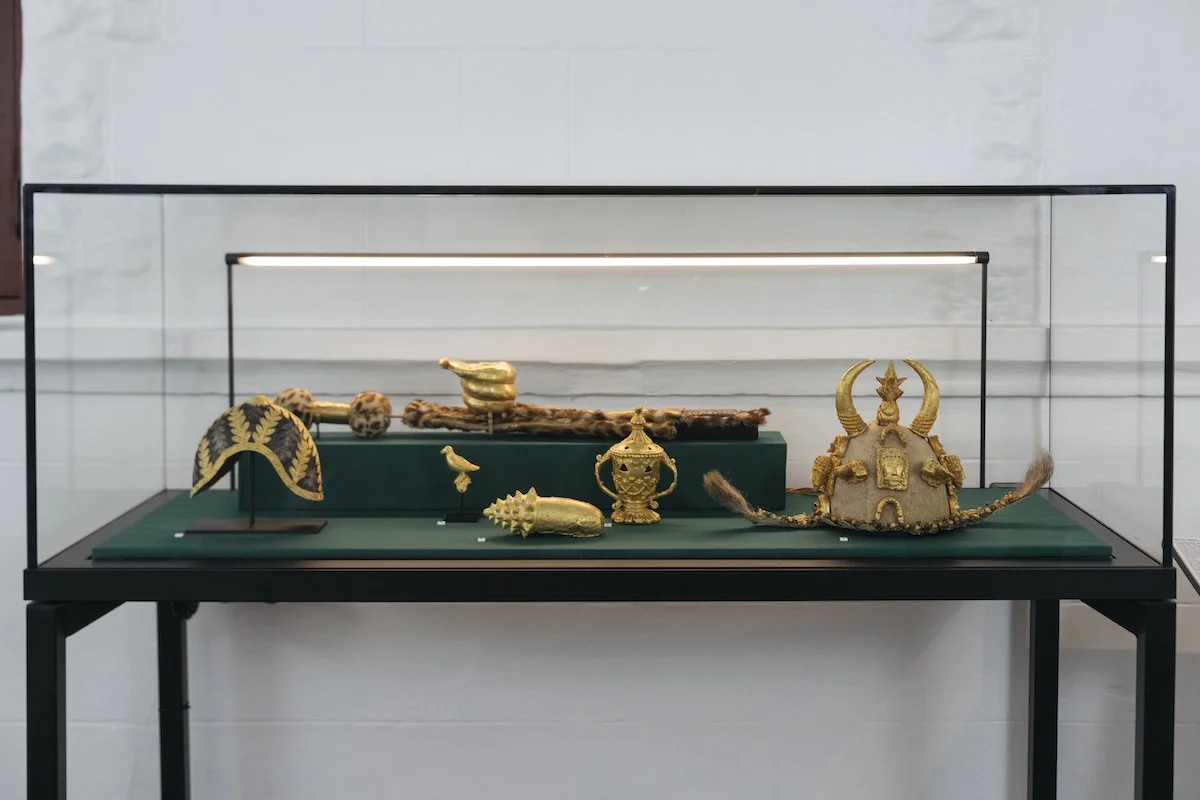
A selection of the Asante regalia lent to Kumasi by the Victoria and Albert Museum and the British Museum. The objects moved; the title did not.
The case for return is strengthening on evidence and on argument. The most useful thing I can do is not to make it again but to imagine the way forward once ownership is resolved. This is about restitution rather than reparations, though in a week when Britain is arguing over whether it can apologise for the slave trade at all, separating them entirely is neither possible nor desirable.
Great strides have been made toward restitution. France handed over the twenty-six royal treasures of Abomey, in the Republic of Benin, at a ceremony in the Élysée. The Fowler Museum in Los Angeles gave seven Asante objects back for good. The Dutch and Germans committed more than two thousand objects to Ghana this summer. The Danes help Ghana maintain the forts they built from the mid-seventeenth century: not a return, but the cooperation I will argue for. All of it was won by people who spent careers appealing for it. This is progress.
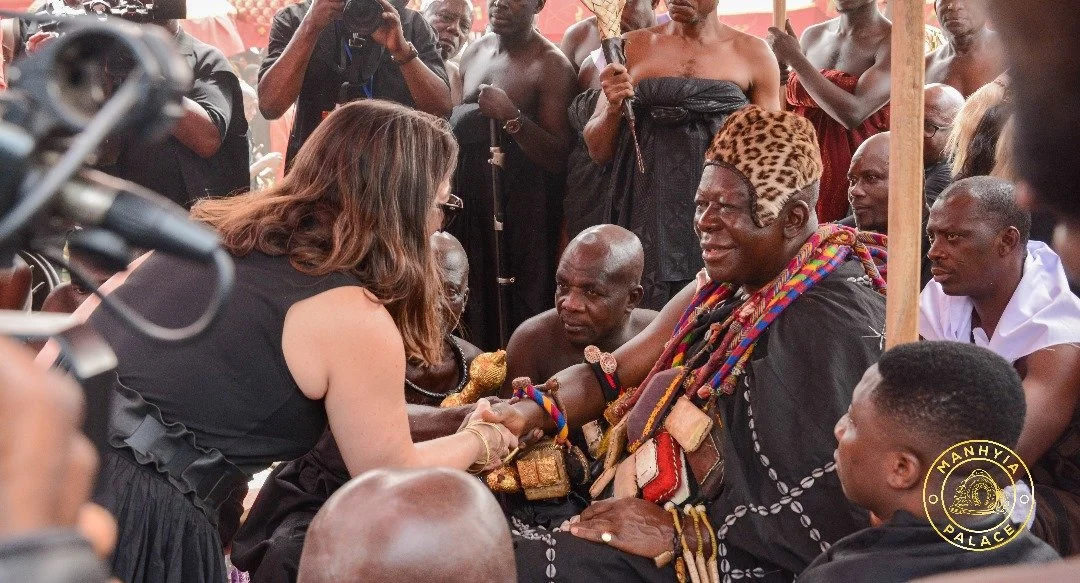
Silvia Forni, director of the Fowler Museum, is received at a durbar on the Dwabrem festival ground at the Manhyia Palace in Kumasi, Ghana, February 2024.
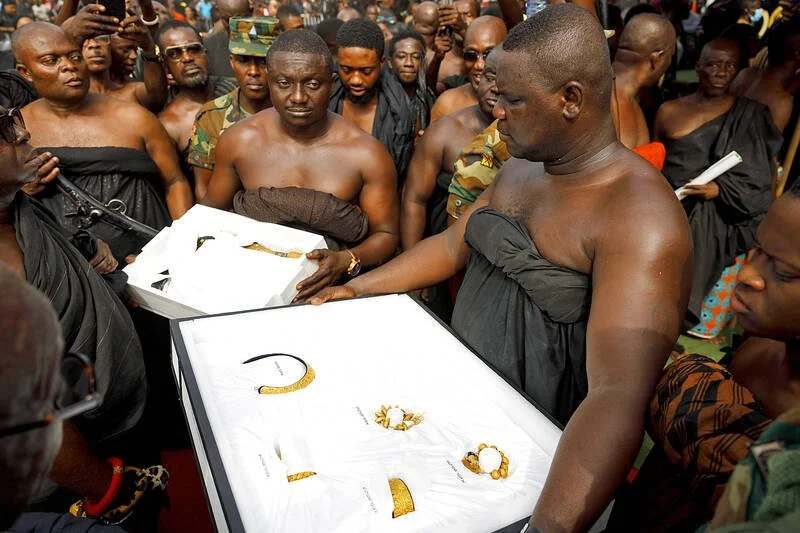
Gold ornaments carried into the durbar at Kumasi, February 2024, on their return from the Fowler Museum in Los Angeles. These were given back for good.
Yet the central question has crystallised into the same stale exchange. On one side, Western institutions traffic in legal antagonism and patronising doubt about Africa's capacity to care for these objects. On the other, critics — I have been one — cast those institutions as parties to an ongoing theft. Each posture answers the other, and the exchange is older than anybody admits. The return of Asante regalia was debated in the House of Lords in 1977; the Ghanaian archaeologist Kofi Agorsah, writing that year, noted that no African country had asked for everything back, and proposed sharing instead. Four years earlier the General Assembly voted on restitution, 113 to 0, with seventeen abstentions — Britain, France and the United States among them.
What Manhyia does not do, and no loan can, is tell the story of what Asante craftsmanship did to the rest of the world. From the 1870s the loot of the punitive expeditions in West Africa flowed into Europe's ethnographic museums, and in those rooms European modernism found its new grammar. Picasso went to the Trocadéro in 1907 and came away with the faces of the Demoiselles d'Avignon. Derain, Vlaminck and the Dresden Expressionists were already collecting and copying African sculpture. The forms travelled into Fauvism and Cubism, out of Cubism into abstraction, and into everything after.
What is remarkable is not the borrowing but how it was described. In 1984 the Museum of Modern Art opened "Primitivism" in 20th Century Art: Affinity of the Tribal and the Modern — a hundred and fifty modern works beside two hundred called tribal. Half of it traced direct influence on modern painters. The other half hung pairs to show "common denominators … independent of direct influences". It was the second idea, affinity, that went into the title. Thomas McEvilley went after the word in Artforum that November: what the museum called a coincidence of taste was a debt to African sculptors, and a mask hung beside a Picasso says nothing about how the Picasso came to look. A debt had been reclassified as a resemblance, a generation after the empires had gone.
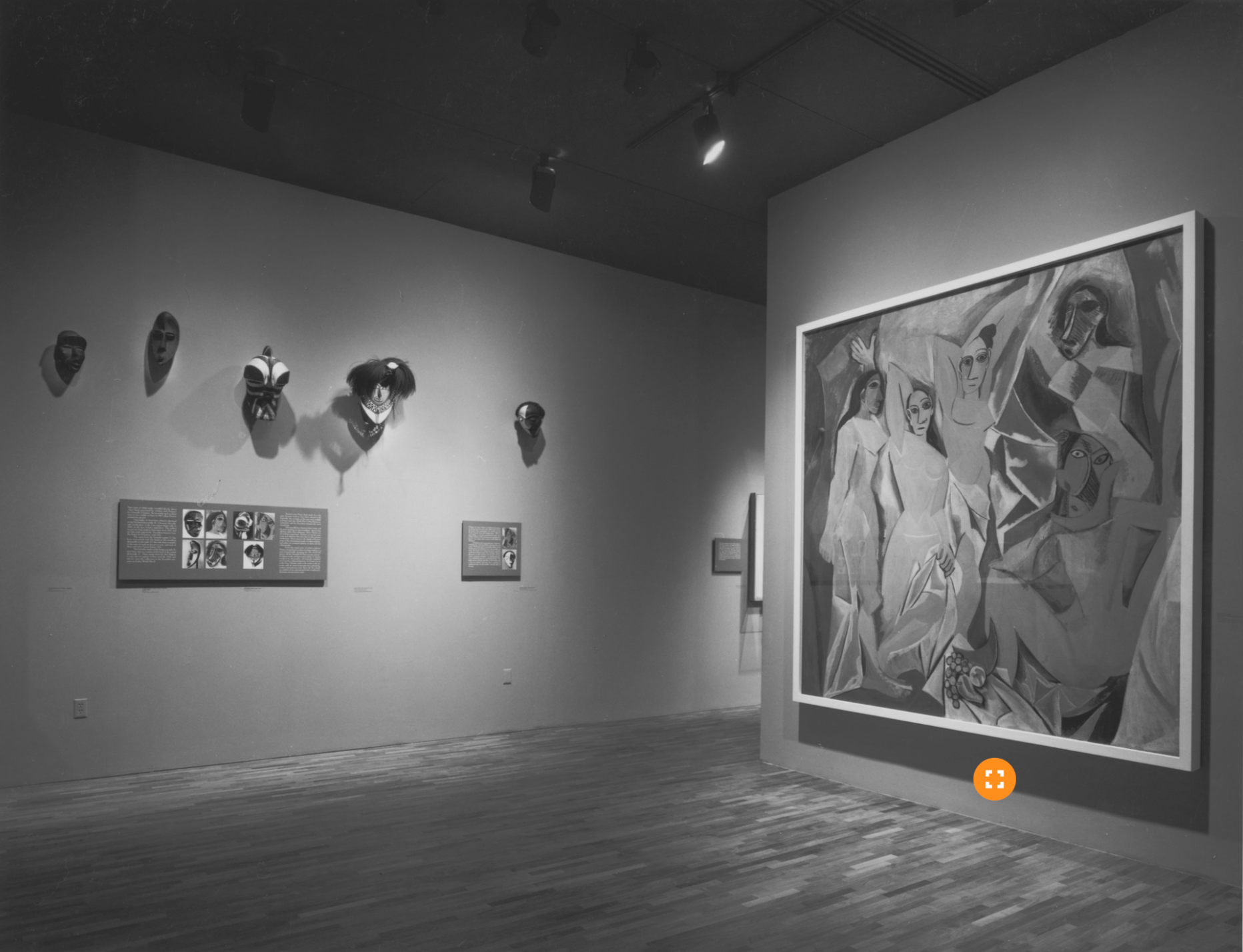
Installation view, “Primitivism” in 20th Century Art: Affinity of the Tribal and the Modern. The Museum of Modern Art, New York, 1984. Photograph by Kate Keller. On MoMA’s website today, the marker over Les Demoiselles d’Avignon identifies it by artist, title and date. Forty-two years after the exhibition, none of the masks on the opposite wall carries one.
This is what happens without a narrative of our own. Unless the countries these objects came from press their account of their contribution to global art history, continuously, the work stays framed in a story that privileges Western artists. The lineage begins in Asante, precolonial Benin, Dahomey; it travels through European modernism into American postwar abstraction; and a young artist in Kumasi or Lagos is entitled to inherit it yet is alienated from it. It also underwrites a market. The African artists selling best today are, art-historically, untethered from precolonial African art: the painters still most readily associated with Benin bronzes and Fon statuary are Picasso and Derain. That is the void the colonial encounter left, and it is an expensive one. An artist read as heir to a tradition that changed world art commands a different price from one read as derivative or charmingly untutored. Disseminating a canon that joins the best of the contemporary to the best of the precolonial would compound the value of both, and it is what decolonising this field would actually consist of: not removing a European frame, but building an African one. A friendship can produce an exhibition. It cannot produce a lineage.
Let me be clear about my position. Title to every object looted in colonial punitive expeditions should transfer, with an apology, to the state and the head of the ethnic group it was taken from, together. The joint form is not a nicety: a chief negotiating one way while a republic claims another is part of what keeps these objects where they are. It needs an Act of Parliament, since the British Museum Act of 1963 forbids the trustees to give anything away; this is a reason to begin now, not to wait. But transferring title does not repair the damage. Would it leave us better placed to tell our own stories? Would it give African artists access to the finest work their forebears made, or establish African production as the equal of any? It would not. The deficits are structural.
Ours are real: no infrastructure to care for and display these objects, and more damagingly no shared sense of how doing so might sustain a productive art sector. Theirs are no longer deniable: Western museums cannot meet the running costs of what they have built, lean harder each year on donors, and hold more than they can show. Beneath it sits the deepest problem: that an imperial nation might chart the cultures of the globe without diminishing some in favour of others. The concept of the universal museum, on which institutions like the British Museum were built, has failed as a monopoly, exhausted by its own curators rather than refuted by its critics. The Benin Bronzes, the most prized objects of African visual culture, sit in the British Museum's lower floors. Would Nigeria put its own treasures in the basement of its National Museum?
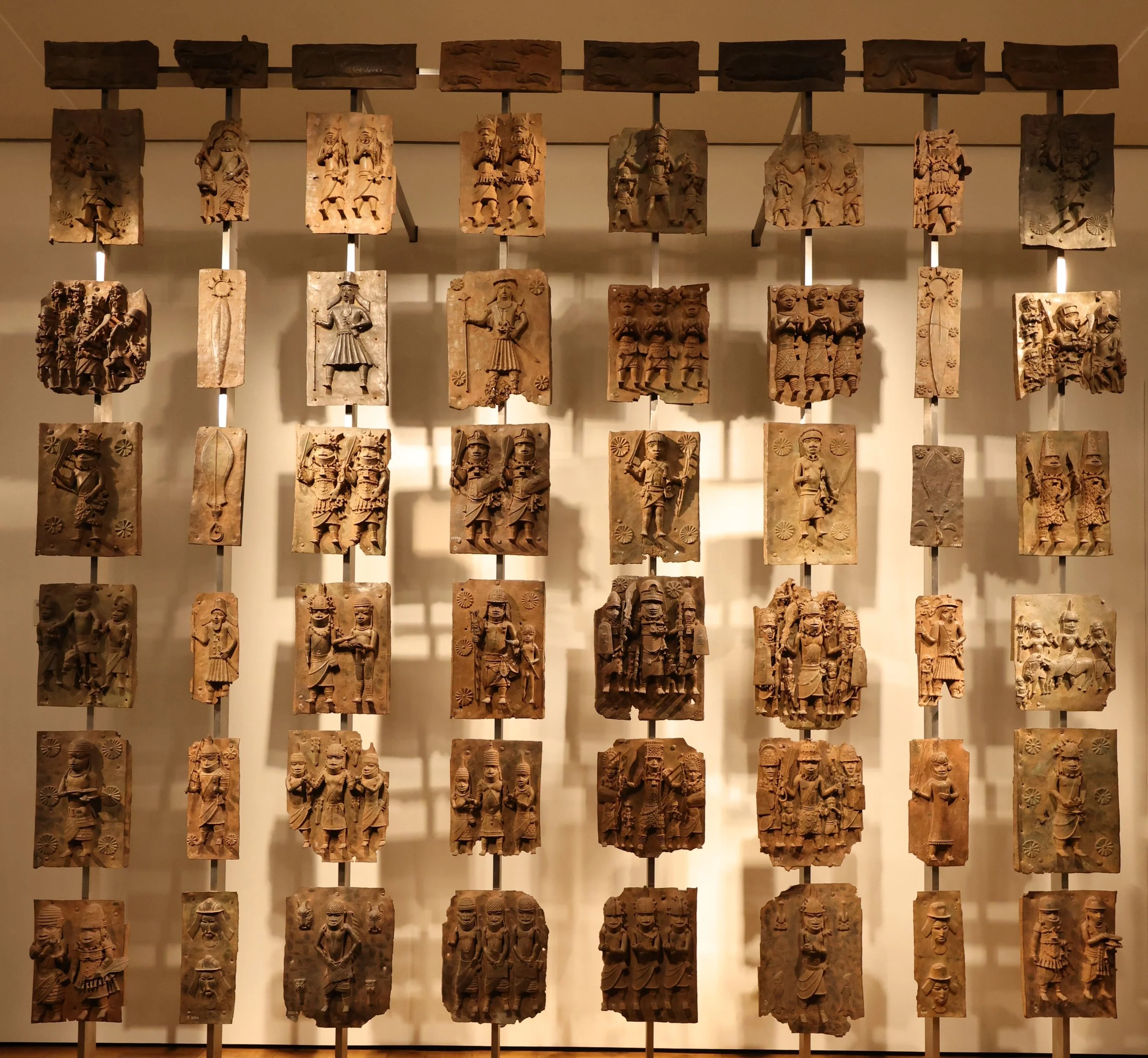
Cast brass plaques taken from Benin City in 1897, displayed in Room 25 of the Sainsbury Galleries, on the lower floor of the British Museum.
The successor to the universal museum is not one encyclopaedia but many: institutions with access to global holdings, each centring its own culture and placing others at the periphery, and saying so plainly rather than pretending to a view from nowhere. Empowering Global South museums to tell stories Western institutions cannot pushes those institutions deeper into their own competence.
The private sector has shown the form. Last week MoMA, the Centre Pompidou and M+ in Hong Kong agreed to share access to their collections, mount exhibitions jointly and pool research. MoMA's director called it making the three of them embassies for each other. The Pompidou's director observed that no single institution can encompass the entire scope of global creativity — the universal museum's founding claim, set aside by its own heirs for practical reasons.
The post-restitution landscape should resemble that model, raised to the level of the state: an alliance of nations rather than of museums. Joint access across national collections, weighted towards what falls under each other's purview: the African works in the National and Royal Collections, acquired legitimately or held in trust until governments can receive them, open to African curators as of right. A common fund for indemnity, insurance and transport, so no institution alone bears the risk of a work in transit. A Grand Tour for young artists of real talent — Accra to London, London to Rome and Athens — and a fund to send students across Africa, Europe and the Americas to exhibit as well as study. Each country contributes on a formula: visitor numbers, the scale of what it holds and of what it needs, plus an endowment from private donors on every continent it touches. The philanthropy that built these collections can fund their circulation.
The obvious objection to this proposition is that it is deferral dressed as partnership, the Kumasi loan again with better stationery. It is not. A loan leaves title unresolved and depends on it staying that way. What I describe assumes title has moved and asks what the two parties do the morning afterwards. France and Nigeria did exactly that in 2002: the Nok statues were returned, and lent straight back to France. An alliance of nations is not an alternative to restitution but an act of speculation as to its desired outcome. Nor is any of it new: a museums exchange programme was set up in 1973 to draft agreements of this kind, and a UNESCO committee for returns in 1978, funded by voluntary contribution and so barely funded. What such an alliance produces is a group of museums that together form an encyclopaedia none of them owns alone, each with a standing reason to care how the others tell it. We would become ambassadors for each other.
